

Why is custom jewelry expensive? The quick answer
A one-off pendant concentrates design, tooling, custom stone cutting and setting costs in a single piece. Mass production spreads those fixed costs across many units. The $200 retail and $2,000 manufacturing examples below illustrate different production scenarios; they are not quotes for identical necklaces.
Why can a necklace retail for $200 in mass production but cost around $2,000 to make as a one-of-a-kind commission? The key difference is not necessarily the metal or gemstone material. In a one-off piece, the workshop may have to develop a new design, cut and fit many nonstandard stones individually, and solve manufacturing problems that a factory can spread across thousands of repeated products.
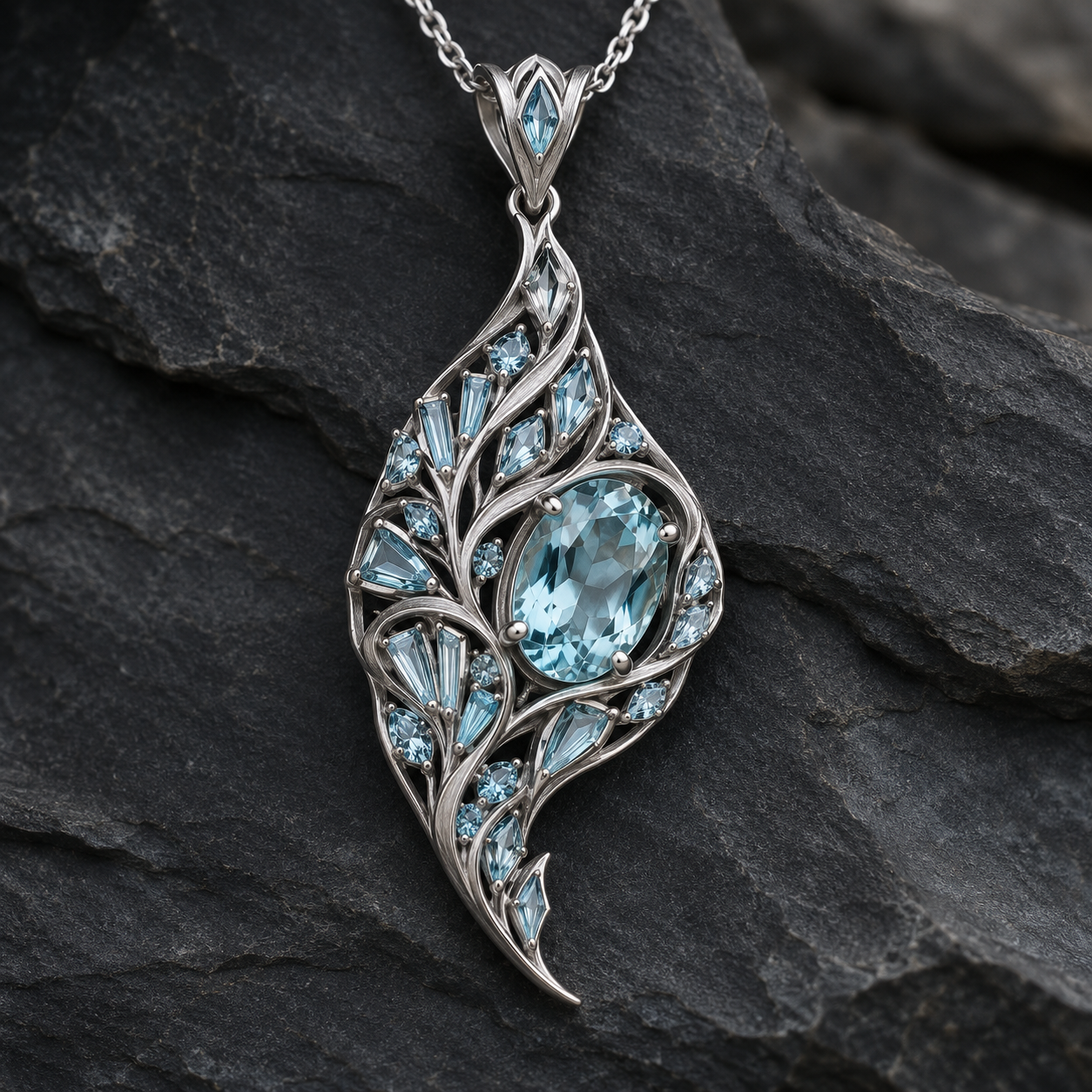
Consider the asymmetric, leaf-shaped pendant concept shown above: an oval aquamarine-colored center stone sits within flowing, silver-toned branches, surrounded by blue accents in varied shapes and sizes. The elongated botanical outline looks delicate, but manufacturing it accurately requires careful engineering. The rendering does not establish actual dimensions, carat weight, or a production-ready stone count.
Image note: The original reference is an AI-generated jewelry concept, not a photograph of a finished piece. The number and shapes of stones are visual estimates subject to engineering verification.
The 25-stone challenge: small gems, high-precision work
The accent stones follow separate seats along curved, leaf-like branches. The mix of tapered, elongated, rounded, and angular outlines can require different lengths, widths, cutting angles, and depths. Some positions may share dimensions; others may not. For the cost examples below, assume a design with 25 accent stones; this is a hypothetical production scenario, not a verified count of the stones in the rendering.
For a single pendant, a cutter may need to measure the metal seats, prepare the rough stones, cut and polish them, and check each finished piece. The maker then has to fit and set those stones individually. A small discrepancy can require reworking a stone or its metal setting. In closely spaced stone settings, tiny errors can be especially visible.
What one-off gemstone cutting actually costs
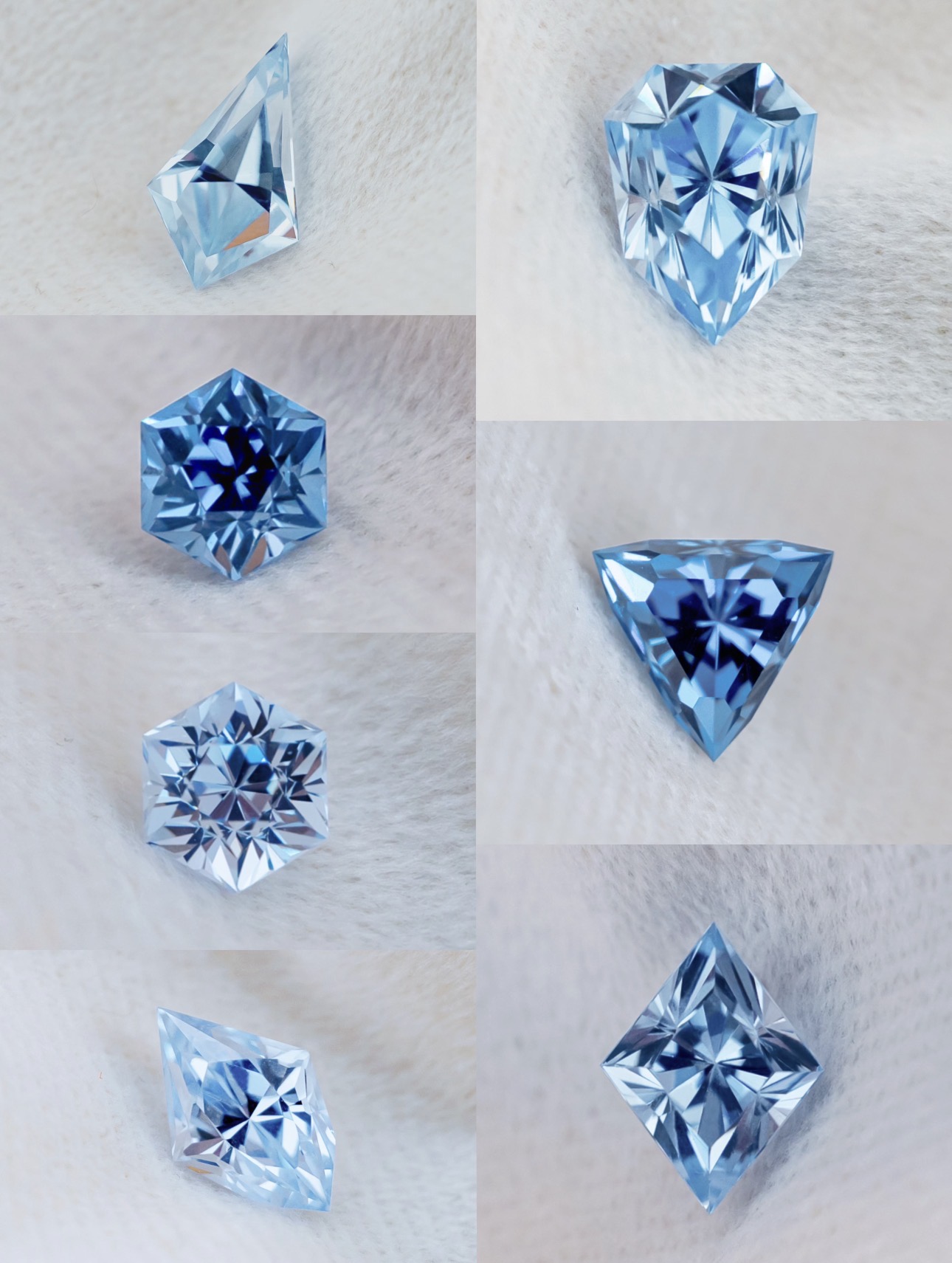
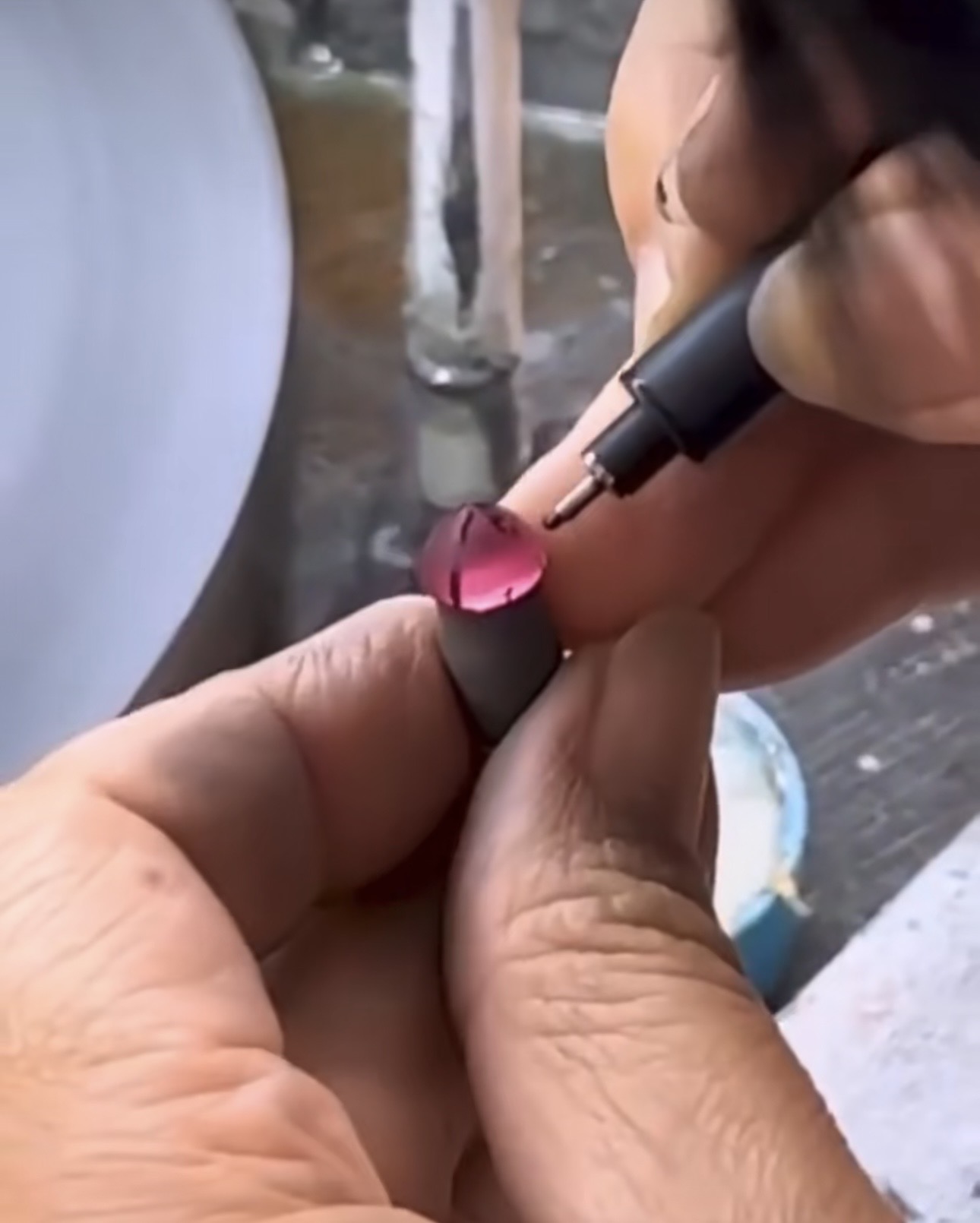
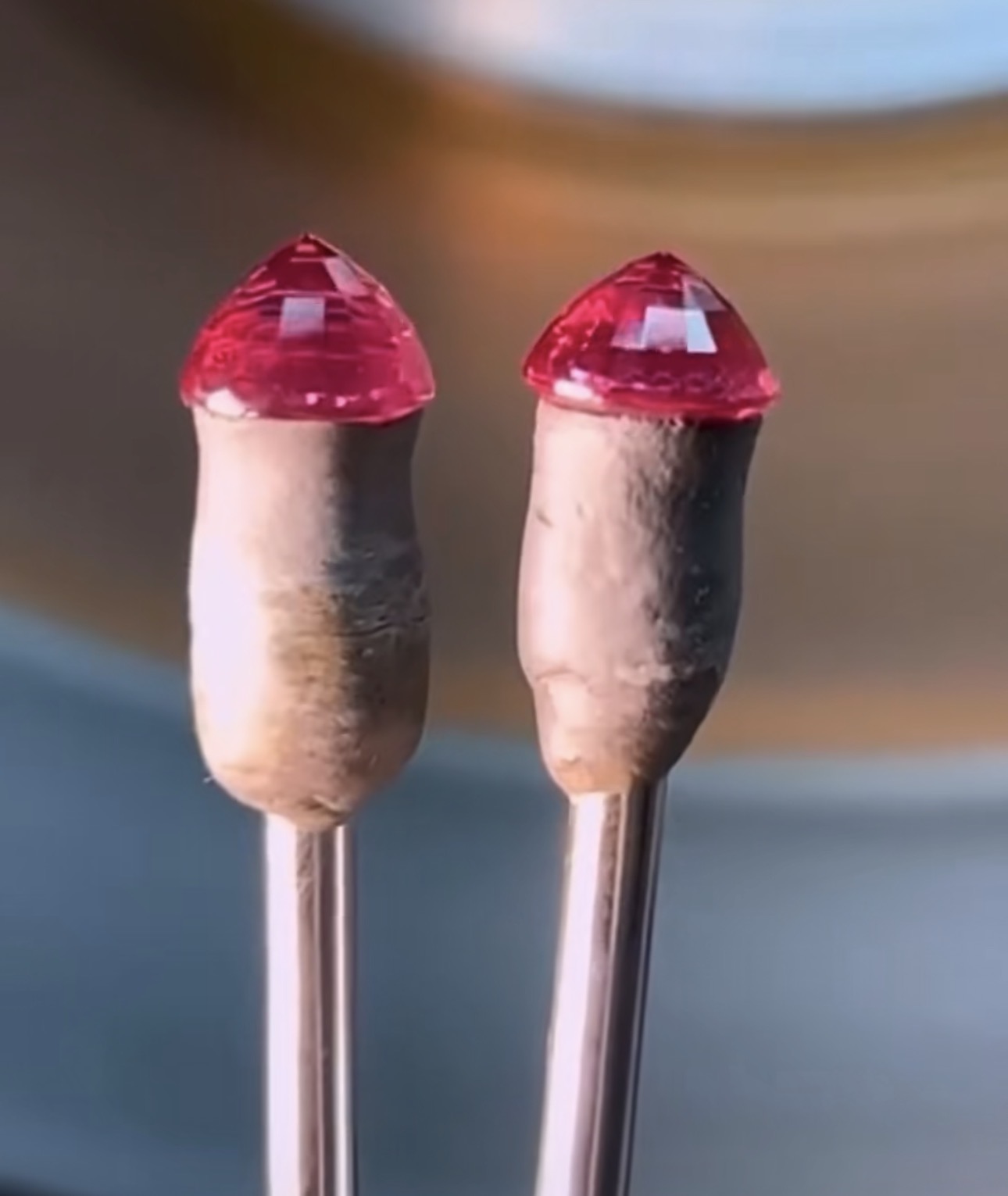
The cost of a gemstone blank is different from the cost of turning it into a precise component. Custom lapidary work involves choosing and orienting material, securing it on a dop, grinding facets, polishing, checking measurements, and sometimes repeating steps until the stone fits the intended setting.
The cutter’s fee reflects skilled labor, setup, inspection, waste, and the risk of breakage. Even when two stones share the same specification, each finished gemstone still requires physical processing and quality control. That’s why 25 inexpensive raw stones do not necessarily become 25 inexpensive ready-to-set stones.
The mass-production secret: standardize first, then use machines
Now imagine manufacturing 10,000 of these pendants. At 25 accent stones each, the factory needs 250,000 accent stones.
Rather than commissioning 250,000 improvised cuts, a manufacturer can redesign the stone seats so that as many positions as possible share a small set of specifications. The exact cut angles, tolerances, fixtures, and quality checks can then be documented. Appropriate mechanized or automated cutting and polishing equipment repeats those operations across large batches.
An illustrative comparison: a complex one-off hand-cut stone might carry a $100 custom cutting fee, while in particularly favorable large-scale conditions the incremental machine-cutting cost of a standardized stone could approach $1. That is a 99% reduction in this example—not a universal industry quotation or guaranteed saving. The $1 figure is not the full landed cost of a finished gemstone: rough material, setup, equipment depreciation, labor oversight, inspection, yield loss, and other expenses still matter.
The lesson is not that machines are magically cheaper for every order. Machines become economical when the design is standardized and the cost of preparing the process is spread over sufficient volume.
Why not use the same machine for just 25 stones?
Automation still requires preparation: accurate specifications, tool paths, holding fixtures, machine setup, sampling, and inspection. For a production run of 250,000 stones, the setup cost per stone can become tiny. For only 25 stones, setup may outweigh the labor saved. Skilled manual work using cutting equipment can be the more economical route.
Suppose specialized development and setup costs $5,000. Allocated across 250,000 stones, that is just $0.02 per stone before variable costs. Spread over 25 stones, it becomes $200 per stone before cutting begins. These simplified figures illustrate the importance of order volume, rather than predicting any supplier’s actual quote.
CAD, molds, and stone setting follow the same economic logic
A factory can reuse a validated CAD model, master pattern, mold, tooling, and assembly instructions. It can solve weaknesses in the sample stage and standardize stone seats so setters spend less time adjusting each piece. High-volume production still needs trained workers and quality control, but much of its development work does not recur for every unit.
With one-off jewelry, the workshop may have to inspect the reference, engineer safe wall thicknesses, determine suitable settings, model the framework, produce the metal parts, and fit the center stone and every accent stone to this specific piece. A customer’s purchase is one pendant; the workshop’s task can resemble an entire new-product development project.
Why AI jewelry images widen the price-expectation gap
AI makes it easy to imagine exquisite jewelry. But a polished rendering does not establish that stones in the picture are available in matching sizes, that the metal is strong enough, or that hinges and floating details could work in real life. Front and side views may even contradict each other.
This is why translating an AI idea into jewelry requires manufacturing interpretation rather than simply tracing the picture. CAD is useful for dimensional precision, but other designs may require wax carving, CNC machining, metal engraving, special stone cutting, or several techniques together. The correct process depends on the construction.
Could a $200 retail piece really cost $2,000 to make once?
Under favorable assumptions—an economical lab-made blue gemstone material, optimized stone shapes, established tooling, and sufficient volume—a similar factory-produced pendant might retail for roughly $200. A one-off version requiring specialized stone cutting, custom silver framework, individual setting, finishing, and engineering could incur roughly $2,000 in manufacturing costs.
These are illustrative scenarios, not verified quotations for identical items. The $200 amount is a hypothetical retail price for a scaled product; $2,000 represents a possible manufacturing cost for a unique piece. They are deliberately not treated as directly comparable cost accounting figures, and a bespoke sales price may also include overhead and margin.
How an experienced custom jeweler can reduce the cost
There may be ways to make the design less costly without losing its identity. A designer can adjust some metal divisions to let more accent stones share dimensions. A few difficult stone shapes might be replaced with decorative metalwork, or a highly complex assembly might be simplified. Every change should be explained visually and technically to the customer before production.
The goal is not to promise an unrealistically low price. It is to explain what the customer is paying for, which details drive the labor, and which alternatives preserve the intended look.
Frequently asked questions
Why is custom jewelry more expensive than mass-produced jewelry?
One-off jewelry often bears design, setup, individual cutting, fitting, and quality-control work that manufacturers can spread across thousands of repeated units.
Can automated gemstone cutting reduce costs by 99%?
It is possible as an illustrative comparison between a specialized one-off cutting fee and a favorable high-volume incremental process cost, but not a generally available discount. Equipment, quality standards, material, shape, and volume determine the actual economics.
Can any AI-generated jewelry image be made into a real piece?
No. Some ideas require structural corrections, alternative stones, different settings, or a redesigned mechanism. The image is a visual brief, not a guaranteed manufacturable blueprint.
Is CAD always the best way to manufacture custom jewelry?
No. CAD can be excellent for dimensionally controlled geometry, while wax carving, CNC work, metal engraving, and skilled lapidary cutting may be more suitable for other features.
Small object, substantial engineering
A pendant can be small and delicate, yet demand a substantial amount of specialized work. The difference between making one and making thousands comes from repeatable design, precision tooling, machinery, and the ability to distribute setup costs over volume.
At OLICONN, we value AI as a creative starting point and human expertise as the bridge to physical manufacturing. Have an idea, a sketch, or an AI image? Send it to us for a free quote. You can also learn more about turning AI jewelry designs into real pieces, what custom jewelry costs, and our custom order process.
Your Imagination. Our Craftsmanship.
Editorial disclosure: This is an anonymized example based on an AI jewelry concept; it is not a finished OLICONN product. Stone count and dimensions require engineering validation. All monetary examples are hypothetical illustrations, not supplier quotations or prices offered to any individual customer.